Calcium-rich volcanic soil, 1,000–1,500 metres, and generations of farming knowledge. Coffee is the clearest illustration of what Bukidnon land can produce — so it is the one we explain in full.
Bukidnon sits in the heart of Mindanao. Its second mountain range — from Lourdes in the south to the northern ridges — gives arabica what it needs: elevation, cool nights, and volcanic soil with a distinctive calcium content that produces a cup unlike other Philippine origins.
The soil shifts as you move north. That creates distinct micro-terroirs across surprisingly short distances, which is what makes the province interesting to a serious buyer rather than just another origin on a list.
The far western slopes are still largely unworked commercially. A road network connecting to the regional centre opens real expansion potential.
The Philippines was once among the world's top five coffee producers. Today it imports roughly 90% of the coffee it drinks. Bukidnon's highlands are one of the better remaining chances to rebuild a globally competitive Philippine arabica supply.
There is a second gap underneath that one: the province produces around 12.5% of Philippine coffee, but 98.9% of it is robusta — on ground that suits arabica. That mismatch is the opportunity in one sentence.
Local processing groups with deep knowledge of the growing areas, existing farmer relationships, and a record of producing quality arabica from the best sites.
Buying stations and processing placed across the key areas — from the southern calcium-rich slopes to the emerging western zones. This is what turns scattered smallholder production into consistent, export-ready supply.
With 1,000+ hectares of suitable ground and real demand from single-source buyers, the economics support a vertically integrated operation rather than opportunistic trading.
Figures are internal analysis, Aug 2026. Verify independently before relying on them.
We work with processing groups and farmer organisations already embedded in the region. Our job is infrastructure, mapping and market access — not displacing anyone who is already doing the work.
Ground-level sourcing maps of the best growing sites, built with local partners rather than from a satellite image.
Buying stations and processing at strategic collection points across the highland growing region.
Direct procurement from smallholder networks at above-market pricing, with traceability from farm to export.
Consistent, graded, export-ready arabica for specialty roasters, single-source buyers and institutional off-takers.
Buying coffee from a community is not the same as acquiring their land. Bukidnon's highland communities, including Matigsalug-Manobo Indigenous peoples, have farmed coffee on ancestral land for generations. We buy from those growers, partner with their organisations, and pay above market. That is a trading relationship.
The land offering on this site remains private title or DENR-designated investment land only — never ancestral domain under a CADT, never community tenure under a CBFMA. Community land is not ours to sell or lease, and we will not blur the two.
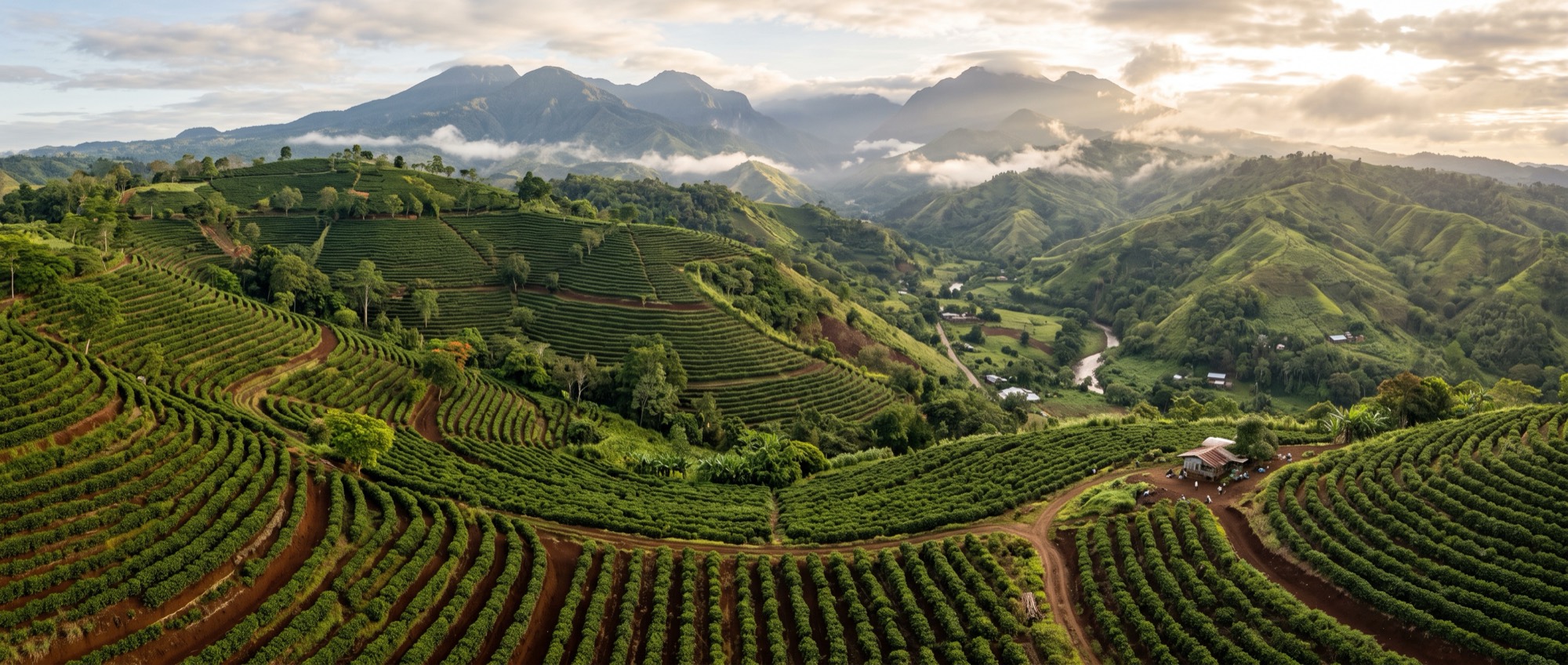
Calcium-rich volcanic soil at 1,000–1,500 m gives a profile distinct from Cordillera and Davao. Southern and northern slopes yield noticeably different cups from the same province.
Highland communities here have grown coffee for generations. This is arabica with real provenance, not a recently planted story.
Bukidnon is also the site of large-scale agroforestry and restoration work. Shade-grown coffee under canopy builds carbon stock and produces premium beans from the same hectare.
Whether you are a specialty roaster after a new Philippine origin, an institutional buyer looking for single-source supply, or exploring the land side — tell us what you have in mind and we will reply with the honest constraints first.